
PSA Oxygen Plant: 7 Powerful Benefits of Reliable Industrial & Medical Oxygen Supply
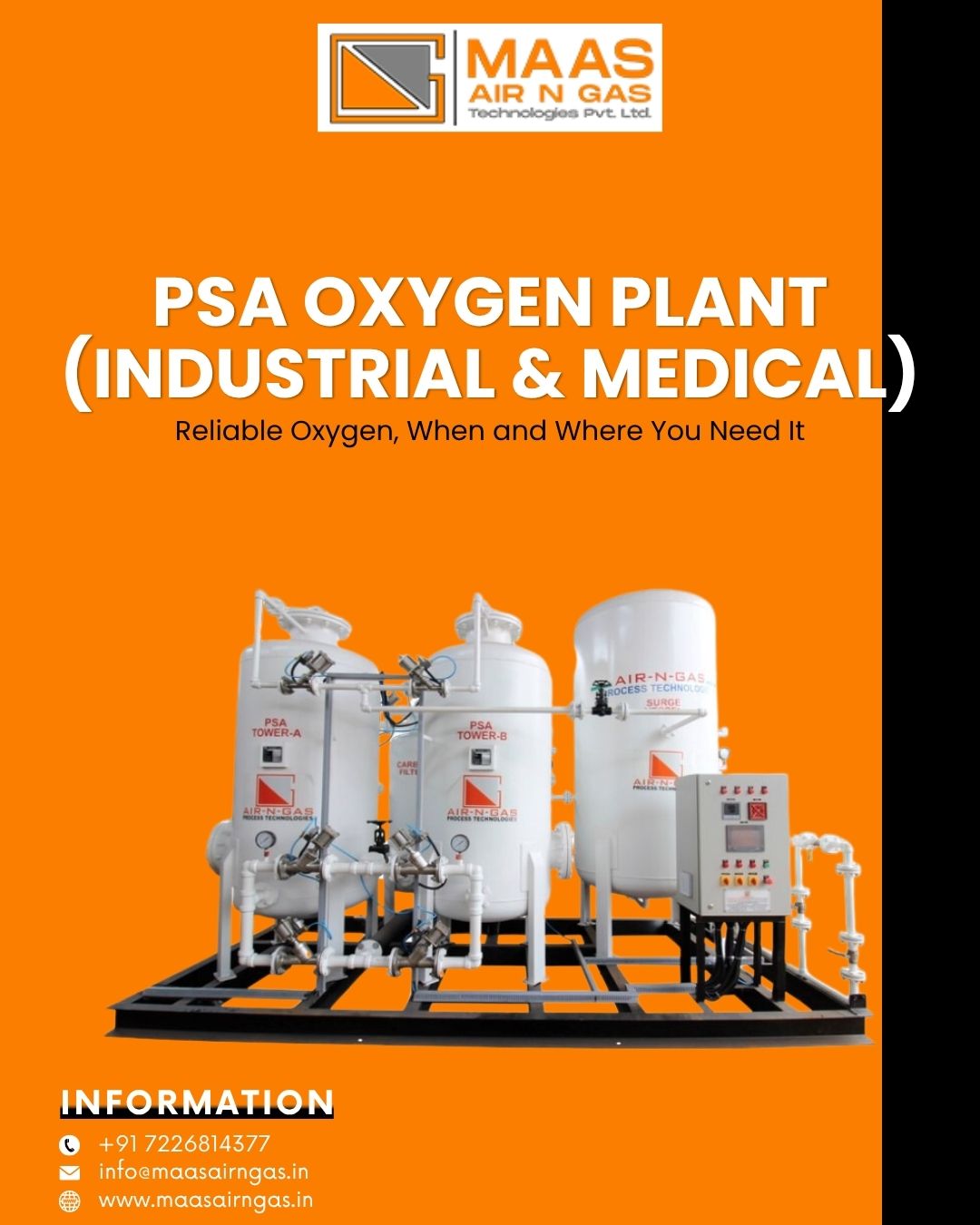
PSA Oxygen Plant for Industrial & Medical Use: Reliable, Cost-Effective, and Future-Ready Oxygen Supply
Table of Contents
- What Is a PSA Oxygen Plant?
- How a PSA Oxygen Plant Works
- Why PSA Oxygen Plants Are Important for Medical and Industrial Use
- Major Applications of a PSA Oxygen Plant
- Key Components of a PSA Oxygen Plant
- Benefits of Installing a PSA Oxygen Plant
- PSA Oxygen Plant vs Oxygen Cylinders vs Liquid Oxygen
- Why Choose Air-N-Gas for a PSA Oxygen Plant
- Frequently Asked Questions
- Conclusion
PSA Oxygen Plant for Industrial & Medical Use
PSA Oxygen Plant technology has become one of the most dependable solutions for organizations that need a continuous, safe, and cost-efficient oxygen supply. Whether the requirement is in a hospital, a fabrication unit, a pharmaceutical facility, a glass plant, or a metal processing operation, a PSA oxygen plant offers the ability to generate oxygen on-site instead of depending on cylinder deliveries or bulk liquid oxygen logistics. That shift matters because oxygen is no longer treated as just another industrial gas; in many sectors, it is a mission-critical utility that directly affects productivity, safety, and service continuity.
In simple terms, a PSA Oxygen Plant uses Pressure Swing Adsorption technology to separate oxygen from compressed atmospheric air. Instead of transporting oxygen from an outside supplier every few days or every week, the plant produces oxygen where it is needed and when it is needed. For hospitals, that means a stable oxygen source for patient care and emergency preparedness. For industries, it means uninterrupted oxygen availability for combustion, oxidation, cutting, welding, and process enhancement.
At a business level, the value of a PSA oxygen plant is even more significant. It reduces dependence on the volatile supply chain of oxygen cylinders, cuts recurring procurement costs, improves operational control, and provides a more predictable long-term cost structure. For organizations looking to scale responsibly while reducing risk, on-site oxygen generation is a practical investment rather than just an equipment purchase.
Air-N-Gas has positioned itself in this segment by offering PSA oxygen generation solutions for both industrial and medical applications, supported by design, manufacturing, installation, and service capabilities in the gas generation space. The company highlights fully automatic operation, application-specific engineering, and long-term service support across its product portfolio.
What Is a PSA Oxygen Plant?
A PSA Oxygen Plant is an on-site oxygen generation system that produces oxygen from ambient air by using adsorbent material—typically zeolite molecular sieve—to separate nitrogen from oxygen. The system works on the principle of pressure swing adsorption, where compressed air is passed through adsorption vessels. Nitrogen is selectively adsorbed by the molecular sieve, while oxygen passes through and is collected for use.
This process is especially valuable because atmospheric air is freely available and contains roughly 21% oxygen and 78% nitrogen. A PSA oxygen plant essentially captures that oxygen portion in a controlled, repeatable, and automated way. In many standard medical PSA systems, oxygen purity generally falls in the range of 90% to 96%, which aligns with common PSA medical oxygen generation standards. Government guidance on medical oxygen management in India also describes PSA-based onsite oxygen generation using zeolite molecular sieves and notes this typical purity range for PSA-generated medical oxygen.
The biggest practical advantage of a PSA oxygen plant is that it turns oxygen from a delivered commodity into an in-house utility. That changes the economics of oxygen consumption, especially for hospitals, mid-sized industrial users, and facilities in remote locations where oxygen logistics can be expensive, delayed, or unreliable.
How a PSA Oxygen Plant Works
A PSA Oxygen Plant follows a sequential process that converts ambient air into usable oxygen. Although the system is technically sophisticated, the working principle can be understood straightforwardly.
First, atmospheric air is drawn into the system and compressed. Compressed air then passes through a treatment section where dust, oil traces, and moisture are removed. Clean and dry compressed air is essential because contaminants can reduce the efficiency and life of the molecular sieve and associated components.
Once treated, the compressed air enters one of the adsorption towers filled with zeolite molecular sieve. Under pressure, the molecular sieve preferentially adsorbs nitrogen molecules, allowing oxygen-enriched gas to pass through. That oxygen is then collected in a receiver or surge vessel. Meanwhile, the second adsorption tower undergoes regeneration. In this phase, the pressure is reduced so the adsorbed nitrogen is released and vented out, restoring the adsorbent’s ability to work in the next cycle.
The system alternates between these towers in rapid cycles. Because one tower produces oxygen while the other regenerates, the plant delivers a near-continuous oxygen output. This twin-tower arrangement is one of the core reasons PSA systems are dependable for round-the-clock operations in hospitals and industrial units.
A well-designed PSA oxygen plant typically includes automation controls, sensors, valves, filtration stages, air storage, oxygen storage, and safety mechanisms to maintain consistent performance. Air-N-Gas positions its oxygen systems as fully automatic and suitable for uninterrupted on-site generation, which is a major requirement in both healthcare and industrial environments.
Why a PSA Oxygen Plant Matters in Medical and Industrial Operations
A PSA Oxygen Plant is not just a machine that produces gas. It is a reliability system. In medical settings, oxygen availability can directly influence emergency response capacity, ICU support, operating theatre readiness, and the ability to handle sudden demand spikes. Hospitals that rely entirely on external oxygen cylinders or tankers are exposed to transport delays, supply shortages, and storage-related challenges. On-site PSA oxygen generation reduces that dependency and improves response capability.
The same logic applies to industrial facilities. In sectors such as steel processing, glass manufacturing, wastewater treatment, welding, metal cutting, pharmaceuticals, and chemical processing, oxygen is a productivity enabler. When oxygen supply is delayed, the issue is not only inconvenience; it can slow production lines, disrupt process quality, and raise operating costs. An on-site PSA oxygen plant gives manufacturers better control over a critical input and reduces recurring vendor dependence.
This is also why PSA oxygen systems have become more prominent in long-term operational planning. They allow organizations to move from a reactive oxygen procurement model to a planned, controlled, and scalable oxygen generation model. That shift is strategically important for businesses that want resilience, cost visibility, and autonomy.
Applications of a PSA Oxygen Plant
PSA Oxygen Plant for Medical Applications
A PSA Oxygen Plant is widely used in hospitals, nursing homes, trauma centers, and specialty medical facilities. Medical oxygen demand can be unpredictable, and the cost of supply disruptions is extremely high. In these environments, PSA oxygen plants are used to support oxygen pipelines, ICUs, emergency wards, and other treatment areas where continuous oxygen flow is essential.
Hospitals increasingly prefer PSA-based systems because they enable on-site medical oxygen generation at a sustainable operating cost. They also reduce dependency on repeated cylinder refills and lower the risks associated with transport and handling of large oxygen inventories. Air-N-Gas’ medical oxygen material also emphasizes ease of installation, low maintenance, automatic operation, and oxygen quality aligned with pharmacopoeia requirements for medical use.
PSA Oxygen Plant for Industrial Applications
In industrial operations, a PSA Oxygen Plant supports a broad range of processes where oxygen improves combustion efficiency, process stability, reaction rates, or product quality. Industries use oxygen for metal cutting, welding, glass furnace enrichment, oxidation processes, fish farming aeration, wastewater treatment, and certain pharmaceutical or chemical applications.
For many industrial users, the decision to install a PSA oxygen plant comes down to economics and control. Cylinder oxygen can become expensive at higher consumption levels, especially when transport, handling, and storage are considered. Bulk liquid oxygen may not be viable for every site, particularly smaller or decentralized facilities. A PSA oxygen plant offers a practical middle path: on-demand oxygen generation without the infrastructure complexity of large cryogenic systems.
Key Components of a PSA Oxygen Plant
A PSA Oxygen Plant performs well only when every major subsystem is engineered properly. While exact configurations vary by capacity and application, the plant generally includes the following components:
1. Air Compressor
The compressor supplies pressurized air to the system. Since the PSA process depends on pressure variation, compressor quality and stability directly affect plant performance.
2. Air Treatment System
This section typically includes filters and dryers that remove moisture, oil, and dust from compressed air. Clean air is critical for protecting the molecular sieve and ensuring consistent oxygen purity.
3. PSA Towers
These are the twin adsorption vessels filled with zeolite molecular sieve. They alternate between adsorption and regeneration cycles to continuously separate oxygen from nitrogen.
4. Oxygen Receiver / Surge Vessel
The oxygen receiver stores oxygen temporarily and helps smooth out flow fluctuations, delivering a more stable supply to the point of use.
5. Control Panel and Automation System
Automation is essential in a modern PSA Oxygen Plant. Timers, sensors, valves, alarms, and PLC-based control systems coordinate the adsorption cycle, regulate performance, and improve operational safety.
6. Oxygen Monitoring and Safety Systems
Medical and industrial users need confidence in oxygen purity and plant reliability. Oxygen analyzers, pressure controls, and safety interlocks help ensure that the system runs within required parameters.
Benefits of Installing a PSA Oxygen Plant
1. Continuous On-Site Oxygen Availability
The most obvious advantage of a PSA Oxygen Plant is the ability to generate oxygen at the point of use. This reduces dependence on external deliveries and makes oxygen available whenever the process or patient load demands it.
2. Lower Long-Term Operating Cost
Although the initial investment in a PSA oxygen plant is higher than simply ordering cylinders, the long-term economics are often far better. Cylinder purchase, transportation, storage, handling, and refill scheduling create recurring costs that add up quickly. A PSA oxygen plant shifts the cost structure toward electricity, routine maintenance, and periodic servicing, which is generally more predictable.
3. Better Supply Chain Control
Supply chain uncertainty is a serious operational risk. With a PSA Oxygen Plant, organizations gain direct control over oxygen generation instead of depending entirely on third-party logistics.
4. High Reliability for Critical Use Cases
Hospitals and process industries need stable oxygen flow, not occasional availability. A properly designed PSA oxygen plant provides a reliable oxygen source for daily operations as well as emergency scenarios.
5. Reduced Handling and Storage Challenges
Cylinder storage requires space, safe handling practices, transport coordination, and periodic monitoring. A PSA oxygen plant reduces these burdens by generating oxygen on-site and limiting dependence on large cylinder inventories.
6. Scalable for Different Capacities
A PSA Oxygen Plant can be designed for different flow rates and pressure requirements depending on whether the end user is a small hospital, a large industrial plant, or a multi-use facility.
7. Automation and Ease of Operation
Modern systems are designed for automated operation. Air-N-Gas specifically positions its PSA systems as fully automatic and low-attention equipment, which is useful for facilities that need reliability without constant manual intervention.
PSA Oxygen Plant vs Oxygen Cylinders vs Liquid Oxygen
When comparing oxygen supply options, the right choice depends on consumption pattern, location, reliability needs, and budget horizon.
Oxygen cylinders are suitable for small and irregular consumption, but they become costly and operationally inconvenient for facilities with sustained demand. There are also challenges related to transport, refilling schedules, and storage management.
Liquid oxygen systems can be effective for large users, but they require specialized storage and may not be practical for every facility. Infrastructure and supply chain coordination can be more complex.
A PSA Oxygen Plant is often the most balanced option for users who need a continuous oxygen supply and want to reduce recurring dependence on vendors. It is particularly attractive for hospitals, medium-scale manufacturers, and remote installations where oxygen logistics can be difficult or expensive.
Why Choose Air-N-Gas for a PSA Oxygen Plant
Choosing the right supplier is just as important as choosing the right oxygen generation technology. A PSA Oxygen Plant is not a commodity item that should be bought only on price. It is a process system that affects uptime, oxygen purity, maintenance cost, and long-term operational confidence. That is where supplier capability matters.
Air-N-Gas brings process specialization
Air-N-Gas focuses on adsorption-based gas separation systems and related process technologies, including PSA oxygen plants, PSA nitrogen plants, air dryers, filters, and gas treatment systems. This matters because oxygen generation systems perform best when the supplier understands the broader compressed air and gas treatment ecosystem, not just the vessel fabrication.
Air-N-Gas emphasizes automation and practical operation
The company highlights fully automatic operation, low-maintenance design, and on-site oxygen generation suited to industrial and medical use. For many buyers, these are not marketing points; they are operating requirements. Facilities do not want a system that needs constant intervention to maintain output quality.
Air-N-Gas offers industrial and medical relevance
Not every oxygen plant supplier has the same level of suitability across both hospital and industrial requirements. Air-N-Gas markets solutions for both use cases, which can be valuable for organizations with diversified applications or future expansion plans.
Air-N-Gas supports quality-focused manufacturing
The company presents itself as an ISO-certified manufacturer with in-house quality processes and experience in gas generation systems. For oxygen plants, quality assurance is important because reliability depends on consistent fabrication, component selection, and process design—not only on the headline purity number.
Air-N-Gas fits the long-term ownership model
A buyer should evaluate not only purchase cost but also installation, commissioning, service, spare support, troubleshooting, and plant optimization over time. A PSA oxygen plant is a long-term operating asset, so after-sales support matters. Air-N-Gas also presents services related to upgrades, maintenance, and system support across its gas generation business, which is a useful indicator for lifecycle support.
Frequently Asked Questions About PSA Oxygen Plant
1. What is the purity of oxygen produced by a PSA Oxygen Plant?
A PSA Oxygen Plant used for medical applications commonly produces oxygen in the range of 90% to 96% purity, depending on plant design, operating conditions, and maintenance quality.
2. Is a PSA Oxygen Plant suitable for hospitals?
Yes. A PSA Oxygen Plant is widely used in hospitals for on-site medical oxygen generation because it provides a continuous oxygen source and reduces dependence on cylinders or liquid oxygen deliveries.
3. Can a PSA Oxygen Plant be used for industrial applications?
Yes. A PSA Oxygen Plant is used in welding, cutting, glass processing, oxidation processes, wastewater treatment, and other industrial applications where oxygen is required regularly.
4. Is a PSA Oxygen Plant fully automatic?
Modern systems are generally designed with automation controls for adsorption cycle switching, monitoring, and alarms. Air-N-Gas also highlights fully automatic operation in its PSA oxygen offerings.
5. How does a PSA Oxygen Plant reduce cost?
A PSA Oxygen Plant reduces cost by generating oxygen on-site, which lowers dependence on recurring cylinder purchases, transport charges, and vendor-related supply delays.
6. What should I check before buying a PSA Oxygen Plant?
You should evaluate oxygen flow requirement, purity requirement, application type, compressor and air treatment quality, automation level, service support, and supplier experience in oxygen generation systems.
Conclusion
A PSA Oxygen Plant is no longer just an optional efficiency upgrade; for many hospitals and industrial users, it is now a strategic infrastructure decision. It offers on-site oxygen generation, supply security, lower dependence on external vendors, and better control over a critical utility. In medical settings, that means stronger preparedness and uninterrupted oxygen availability. In industrial settings, it means stable production support, better process continuity, and more predictable operating costs.
For organizations evaluating oxygen generation solutions, the real question is not whether oxygen is important; it is whether the current oxygen supply model is reliable, scalable, and economical enough for the future. A well-designed PSA Oxygen Plant addresses that problem directly by combining automation, on-demand oxygen generation, and long-term operating efficiency.
If the goal is to invest in a dependable oxygen generation system for industrial and medical use, Air-N-Gas is positioned as a practical partner with experience in adsorption-based gas generation, oxygen plant engineering, and process support. For businesses and hospitals that want a safer and more controlled oxygen supply model, a PSA Oxygen Plant remains one of the most effective choices available today.