
Heatless Dryer: 7 Powerful Benefits of an Efficient and Reliable Compressed Air Drying Solution
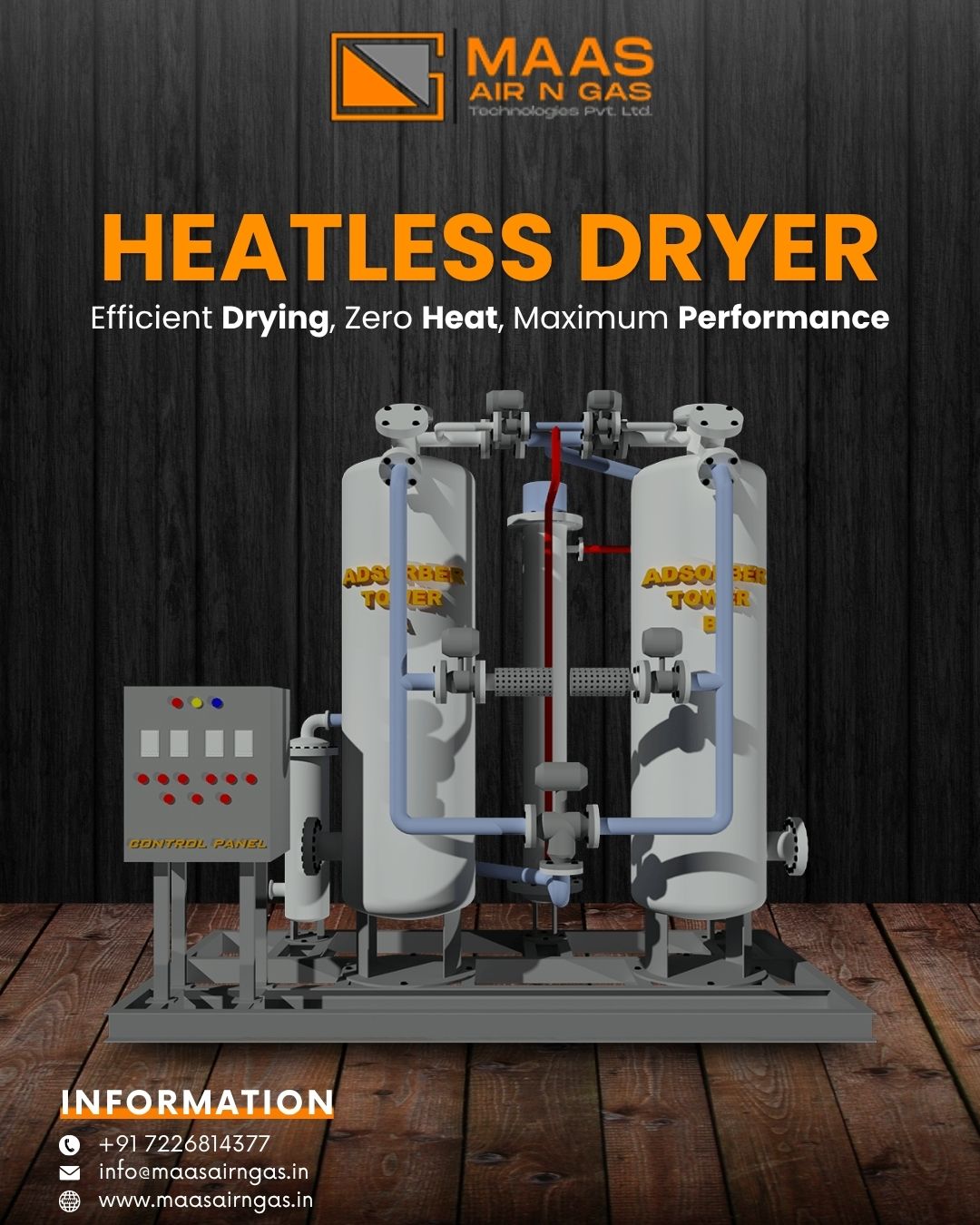
Heatless Dryer: A Reliable Solution for Ultra-Dry Compressed Air in Industrial Applications
Table of Contents
- What is a Heatless Dryer?
- Why Moisture in Compressed Air Is a Serious Industrial Problem
- How a Heatless Dryer Works
- Key Components of a Heatless Dryer
- Major Benefits of a Heatless Dryer
- Industries Where Heatless Dryers Are Commonly Used
- Heatless Dryer vs Other Compressed Air Dryers
- How to Select the Right Heatless Dryer
- Why Choose Air-N-Gas for a Heatless Dryer
- Frequently Asked Questions
- Conclusion
Heatless Dryer: A Reliable Solution for Ultra-Dry Compressed Air in Industrial Applications
Heatless Dryer technology plays a critical role in industrial compressed air systems where dry, clean, and dependable air is essential for production quality, equipment protection, and process stability. In many plants, compressed air is often called the fourth utility, but its value depends heavily on its quality. If that air contains moisture, it can corrode pipelines, damage pneumatic tools, contaminate sensitive products, reduce machine life, and trigger costly shutdowns. This is exactly where a Heatless Dryer becomes one of the most practical and dependable air treatment solutions.
A Heatless Dryer is a type of desiccant air dryer designed to remove water vapor from compressed air without using external heat for regeneration. It is widely used in industries that need a very low-pressure dew point and uninterrupted dry air supply. Compared to many conventional drying methods, a Heatless Dryer is valued for its simple operating principle, compact design, consistent dew point performance, and suitability for critical applications such as pharmaceuticals, electronics, food processing, medical gases, chemical processing, automotive plants, and instrumentation systems.
At Air-N-Gas, compressed air and gas treatment solutions are built around performance, process reliability, and long-term operating value. The company manufactures a wide range of industrial air and gas systems, including compressed air dryers, PSA gas generators, air filters, chillers, and related equipment for demanding industrial environments. With experience in adsorption-based systems and air treatment, Air-N-Gas focuses on delivering drying solutions that help users protect production assets while maintaining the quality of the final output.
What Is a Heatless Dryer?
A Heatless Dryer is an adsorption-based compressed air dryer that removes moisture from compressed air by passing it through a desiccant bed. The desiccant adsorbs water vapor from the air stream and produces dry compressed air at a low dew point, often suitable for highly moisture-sensitive applications. The term “heatless” means that the regeneration of the saturated desiccant does not require an external heater. Instead, a portion of the already dried compressed air is expanded and used as purge air to regenerate the off-line desiccant tower.
Most Heatless Dryer systems operate on a twin tower design. One tower remains in drying mode while the other tower undergoes regeneration. After a fixed cycle time or based on process control logic, the towers switch roles. This alternating process ensures a continuous supply of dry compressed air without interrupting production. The design is mechanically straightforward, which is one reason a Heatless Dryer remains a preferred choice in a wide range of industrial environments.
In practical terms, a Heatless Dryer is selected when the plant cannot tolerate moisture in the air line. If the process requires a low pressure dew point, protection from condensation, and reliable drying in varying operating conditions, a Heatless Dryer is often the correct solution.
Why Moisture in Compressed Air Is a Serious Industrial Problem
Compressed air naturally contains water vapor because atmospheric air always carries moisture. During compression, the air temperature rises, but as the compressed air cools downstream, that moisture condenses into liquid water. If this moisture is not removed properly, it can create multiple problems across the air network and the production line.
Moisture in compressed air can corrode pipelines, valves, pneumatic cylinders, and control instruments. It can wash away lubricants from air tools, create sticky sludge when mixed with oil and dust, and cause malfunction in sensitive actuators and instrumentation systems. In industries like food, pharma, electronics, and healthcare, moisture contamination can also compromise product quality, packaging integrity, and process hygiene. Desiccant dryers are specifically used when applications require pressure dew points below 0°C, and heatless desiccant dryers are one of the standard methods for achieving that result.
From an operating cost perspective, moisture can quietly become expensive. It increases maintenance frequency, shortens equipment life, raises rejection rates, and contributes to unplanned downtime. A well-designed Heatless Dryer helps avoid these issues by delivering stable dry air to the downstream process.
How a Heatless Dryer Works
The working principle of a Heatless Dryer is based on adsorption. Wet compressed air enters one of the desiccant-filled towers and passes through the desiccant bed. As the air flows through the tower, water vapor is adsorbed by the desiccant material, leaving dry compressed air at the outlet. While this first tower is drying the process air, the second tower remains off-line and undergoes regeneration.
Regeneration in a Heatless Dryer happens by using a small portion of the dry outlet air as purge air. This dry purge air is expanded to near atmospheric pressure and sent through the saturated desiccant bed in the second tower. Because the purge air is very dry and at lower pressure, it pulls the adsorbed moisture out of the desiccant and carries it to the exhaust. Once regeneration is complete, the regenerated tower is repressurized and made ready for the next switch-over cycle.
This twin-tower sequence repeats continuously. One tower dries while the other regenerates. The cycle timing, valve sequencing, purge arrangement, repressurization control, and desiccant quality all influence the performance of the Heatless Dryer. According to industry references on desiccant dryers, heatless designs are preferred for applications requiring reliable low dew points and a relatively simple operating mechanism. They commonly use purge air for regeneration, which is an important design consideration when calculating total system efficiency and compressor capacity.
Key Components of a Heatless Dryer
A typical Heatless Dryer includes two pressure vessels or towers filled with desiccant. These towers form the core of the drying process. Along with the towers, the system includes inlet and outlet valves, purge valves, silencers, check valves, control piping, filters, and an automatic control panel that manages the timing of adsorption and regeneration cycles.
The desiccant itself is one of the most important elements of the dryer. Depending on the design and application, common desiccant materials can include activated alumina, molecular sieve, or silica gel. The correct desiccant selection affects dew point stability, service life, and pressure drop. Pre-filters and after-filters are also important because they protect the desiccant from oil aerosols, dirt, and particulate contamination while also ensuring that the downstream air quality remains suitable for process use.
The control panel in a modern Heatless Dryer is not just an electrical box; it is the operating brain of the system. It coordinates tower switching, purge control, repressurization, alarms, and in some designs, dew-point-based control logic. When engineered properly, these elements work together to produce stable, low-moisture compressed air with minimal process interruption.
Major Benefits of a Heatless Dryer
The biggest advantage of a Heatless Dryer is its ability to deliver very dry compressed air. For applications where even small amounts of moisture can affect quality or damage equipment, this is a major benefit. Many industrial users choose a Heatless Dryer because it can achieve low pressure dew points suitable for sensitive processes, cold climates, and critical instrumentation.
Another strong advantage is operational simplicity. Since the dryer does not rely on external heaters for regeneration, the design is comparatively straightforward. This simplicity can translate into easier maintenance, reliable operation, and reduced complexity in environments where robust equipment is preferred. Heatless desiccant dryers are often selected for remote or harsh industrial sites for this reason.
A Heatless Dryer also supports process consistency. Stable dry air means fewer moisture-related disturbances in valves, actuators, filling lines, packaging systems, air tools, and product-contact operations. In sectors where production reliability matters every hour of the day, that consistency directly contributes to output quality and maintenance savings.
The fourth benefit is equipment protection. Dry compressed air helps prevent corrosion in pipelines and downstream components. It also reduces the formation of sludge, rust, and water carryover in air receivers and process lines. Over time, this can lower maintenance expenditure and improve the usable life of the entire compressed air network.
The fifth benefit is application flexibility. A Heatless Dryer can be used across multiple industries and can be integrated into new as well as existing compressed air systems. Whether the plant is handling instrumentation air, process air, packaging air, nitrogen generation feed air, or critical utility air, the same drying principle remains highly effective when sized and configured correctly.
Industries Where Heatless Dryers Are Commonly Used
A Heatless Dryer is widely used wherever compressed air quality directly influences productivity, safety, product quality, or equipment life. In the pharmaceutical industry, dry air is important for packaging lines, pneumatic controls, process instrumentation, and product handling. Moisture contamination can affect both process reliability and compliance-sensitive operations.
In the food and beverage sector, dry compressed air helps maintain hygienic conditions and protects packaging, conveying, and control systems from moisture-related issues. In electronics manufacturing, even small levels of moisture can create quality concerns in sensitive assembly environments. In automotive plants, dry compressed air is essential for paint shops, automation systems, pneumatic tools, and control loops.
A Heatless Dryer is also relevant in chemical processing, textiles, power plants, engineering workshops, instrumentation networks, medical gas-related support systems, and gas generation systems that require dry inlet air. In fact, adsorption-based air drying is often a necessary upstream requirement for PSA-based gas generation systems because moisture must be controlled before air enters the separation stage.
Heatless Dryer vs Other Compressed Air Dryers
When selecting a dryer, many buyers compare a Heatless Dryer with refrigerated dryers, heated desiccant dryers, blower purge dryers, or heat of compression dryers. Each technology has a valid place in compressed air treatment, but the right choice depends on the required dew point, energy priorities, flow rate, and process sensitivity.
A refrigerated dryer is usually suitable when the application only needs moderate moisture removal and a higher dew point is acceptable. It is a cost-effective option for many general-purpose uses, but it is not designed for ultra-dry air in critical applications. A Heatless Dryer, on the other hand, is preferred when the system needs a low dew point and moisture-sensitive performance.
A heated desiccant dryer or blower purge dryer reduces the amount of compressed air used for regeneration by using heat and, in some cases, ambient air blowers. These systems can be more energy-efficient in larger capacities, but they also involve higher complexity and higher initial investment. A Heatless Dryer remains attractive because of its simpler design, lower mechanical complexity, and dependable low-dew-point performance, especially in small to medium industrial systems or applications where rugged operation is a priority. Industry references note that heatless dryers use a portion of dry compressed air for purge regeneration, while heated and blower-purge designs reduce that purge demand through external heat or blower-assisted regeneration.
How to Select the Right Heatless Dryer
Choosing the right Heatless Dryer is not only about matching a model number to a compressor. The dryer must be selected based on air flow rate, working pressure, inlet air temperature, ambient conditions, required pressure dew point, application sensitivity, and the quality of upstream filtration. A poorly sized dryer can lead to pressure drop, unstable dew point, excessive purge loss, or premature desiccant loading.
The first step is to understand the actual compressed air demand of the plant rather than just the nominal compressor rating. The second step is to define the required outlet dew point based on the process. Not every application needs the same dryness level. The third step is to evaluate the inlet air quality, especially the oil and particulate load, because contamination can damage desiccant performance. The fourth step is to assess future expansion, so the dryer does not become undersized after a production upgrade.
It is also important to evaluate the purge air requirement of the Heatless Dryer and factor that into the total system capacity. Because heatless regeneration uses a portion of dried compressed air, the dryer should be selected with a proper understanding of net delivered air versus gross compressor output. This is where an experienced manufacturer or system integrator becomes valuable.
Why Choose Air-N-Gas for a Heatless Dryer
Choosing the right supplier matters almost as much as choosing the right dryer technology. A Heatless Dryer should not be treated as a commodity item if the compressed air system is critical to plant output. What users generally need is a supplier that understands adsorption-based air treatment, sizing logic, application conditions, and long-term serviceability.
Air-N-Gas Process Technologies positions itself as a manufacturer and solution provider in adsorption-based gas separation systems, compressed air dryers, air filters, and related industrial equipment. The company highlights experience in design, manufacturing, installation, commissioning, and support for industrial air and gas systems. Its product portfolio and quality-oriented positioning make it relevant for users looking for integrated compressed air treatment and gas-generation support solutions rather than only standalone equipment.
Why choose Air-N-Gas for a Heatless Dryer
Air-N-Gas can be positioned strongly in this segment for several reasons. First, the company operates in the broader ecosystem of adsorption-based process technologies, which is directly relevant to Heatless Dryer performance. Second, it offers not only dryers but also associated products such as filters, gas generators, and other process utilities, which helps customers build a more integrated compressed air and gas treatment setup. Third, its industrial focus and experience allow it to understand application-specific challenges rather than offering one-size-fits-all equipment.
From an SEO and conversion perspective, this section is important because industrial buyers do not search only for “what is a heatless dryer”; they also search for Heatless Dryer manufacturer, Heatless Dryer supplier in India, industrial compressed air dryer company, and desiccant dryer for low dew point applications. That is where a company like Air-N-Gas should position its offering clearly.
Frequently Asked Questions
What is a Heatless Dryer used for?
A Heatless Dryer is used to remove moisture from compressed air in industrial systems where low dew point air is required. It is commonly used in pharmaceuticals, food processing, electronics, chemicals, automotive plants, instrumentation air systems, and gas generation setups.
How does a Heatless Dryer work?
A Heatless Dryer uses desiccant material to adsorb moisture from compressed air. It typically has two towers. One tower dries the air while the other regenerates using a portion of the already dried compressed air as purge air. The towers switch automatically to ensure continuous dry air output.
What is the advantage of a Heatless Dryer over a refrigerated dryer?
A Heatless Dryer can achieve much lower dew points than a refrigerated dryer. This makes it suitable for moisture-sensitive applications where refrigerated dryers may not provide sufficient dryness.
Does a Heatless Dryer consume compressed air during regeneration?
Yes. A Heatless Dryer uses a portion of dry compressed air as purge air for regenerating the desiccant bed. This is a normal part of its operation and must be considered during sizing and system design.
Which industries need a Heatless Dryer the most?
Industries such as pharmaceuticals, food and beverage, electronics, chemical processing, hospitals, packaging, textiles, and automotive manufacturing often benefit from a Heatless Dryer because these sectors depend on clean and dry compressed air.
How do I choose the correct Heatless Dryer capacity?
The correct Heatless Dryer should be selected based on air flow rate, pressure, inlet temperature, desired dew point, air quality, ambient conditions, and application criticality. It is advisable to consult an experienced compressed air system provider like Air-N-Gas for proper sizing.
Conclusion
A Heatless Dryer is one of the most dependable solutions for removing moisture from compressed air when low dew point performance is essential. Its twin-tower adsorption design, continuous operation, and relatively simple regeneration mechanism make it a strong choice for industries that cannot afford moisture-related equipment damage, process inconsistency, or product quality issues. Whether the requirement is instrumentation air, packaging air, process air, or dry air for a gas generation system, a properly selected Heatless Dryer can significantly improve system reliability and downstream protection.
For industrial buyers, the decision should not be based only on the dryer type but also on system design quality, desiccant performance, controls, filtration, and supplier expertise. That is where Air-N-Gas can be positioned as a practical technology partner for compressed air drying and adsorption-based process systems. If your facility needs dependable dry compressed air, a Heatless Dryer is not just a utility add-on; it is a process-protection investment that directly supports quality, uptime, and long-term operating efficiency.